Friday, August 07, 2015

Personal stories: why there is a place for them and why I don't!


A few days ago I was asked to tell a personal story, one about moving here to the states. I did. Move to the States, but also tell the story! It was not really a story, but a few recollections put together in the moment with a few people – all adults. Never thought about it before, just did it. Most likely sounded like it too! But I added some humor, and might work on it a little!

Then today I was asked by a person who attended one of my workshops more about personal stories. I don’t normally tell them. I have seen some awful personal storytellers and I have seen brilliant personal storytellers. I first heard Meg Gilman who set the bar pretty bloody high, so others need to be very much on, A-Game. I used to go to a lot of poetry slams when I lived in Portland, Oregon, and having to sit through the psychotherapy poems which should only have been heard by a therapist to get to the good and great works got too much for me. I feel the same with the Moth. All the stories are brilliantly told, but some of the stories are not anything I feel the teller would want to share with the whole Western world!

These exposures of intimate, personal life, be it in poems or story have left a shadow over me about doing my own personal stories. Why bother, I think, when the older, folk and faerie tales, the myths and legends are so much better – or at the very, very least have been told for thousands of years for a reason – they are so good they won’t go away! How many personal stories or poetry slams are like that? How many will be told in some form 50 years from now? How many BOOKS will be in print still then? Get my point? Don’t get me wrong, I have nothing against really good personal storytellers and their work, I love what they do, and enjoy it. I just choose not to do it myself, except in my teaching role or in very rare moments like yesterday.

As with poetry, there is I believe, a real issue with personal stories. Some personal stories when told, feel really good for the teller/performer. They think they are sharing a powerful story (true on many counts) but these same powerful stories leave the listener extremely uncomfortable. At those times the lesson (if there is one) and story is lost because people want to forget about what they heard, they cannot take on the weight or emotion of that story. It was too personal for them and not crafted in a way that gave the power, or message, and instead only rawness.

Photo by Simon Brooks

©
2015
I recently led a workshop for adults, and it was interesting that the men mostly chose to tell personal stories which were filled with action, and stories that had humor. The women of the group told very personal tales rich with emotion and feeling. One of these emotional stories was on the right side of the edge of raw. It was just balanced enough to work, thank goodness, and was told in such a way and with great compassion, the story came out filled with meaning. It was a story of the loss of a child. It could have been too much, too raw. This participant was struggling with which story to tell. The one we worked on was great, but also quite raw, and we talked about the motivation of such a story - what is the REASON for sharing the tale/experience. The other story, the one eventually told, was not one she and I worked on. Both memoirs were very powerful. There is a fine and delicate line, I believe. The teller needs to know WHY they are telling it and needs to look very carefully and deeply at the answer. It is too easy for a very personal story becoming something like a therapy session for the teller, and an agony and embarrassment for the listener! The teller wants to create empathy with the listeners and not make the audience so uncomfortable they want to forget what they heard, or leave. (Also see my blog on telling the wrong story to wrong audience.) There is art in this craft, and both the women tellers nailed it at the performance.

It takes deep searching when stories are raw and keen-edged, if you will. If the are considered being told one needs to make sure the tale can be presented with a purpose of teaching or positive sharing and not as self-indulgent therapy. There is much to be learned from each others stories. By sharing our personal stories we find empathy and understanding with each other.

Photo by Simon Brooks
©
2015
As an immigrant myself, getting kids in schools where there is a high population of immigrants to share their experiences gives the students a chance to let people know why they came to the States, or what horrors, or such poor living standards they left behind. Kids who are bullied can tell stories to let others know how it makes them feel in a way their peers can understand. Racism, sexism, all those negative ‘isms’ are bullying. We need more empathy.  In this age where real personal connection is so greatly lacking, it is easy to tell too much too soon, putting all of yourself out there. This is not always a good thing, as I have found out in the past. Information can be power in the wrong hands!

As a race of silly old human beings we need to know we are all the same ("If you prick us, do we not bleed?/if you tickle us, do we not laugh? if you poison/us, do we not die?"-William Shakespeare, Merchant of Venice, Act 3, Scene 1) – now more than ever. We are people with our own pain and hurts, our own griefs and grieving, our own foibles and fancies, and we need to know we are not alone in all this; our stories are different yet connect us to each other and the world we live in. We need to do it artfully and thoughtfully, and, as with most things, we also need to listen with compassion.

Peace,
Simon

Saturday, August 01, 2015

LIVE! And in the moment.

Practicing, circa 1980

There is something special about performing. My first exposure, like most peoples, was in the school play, or first school musical presentation, but back then I was still learning my craft, insanely nervous, or just goofing around with friends, and not in the moment. My first real taste of that something special was when I was 14 or 15 and my dad had me sit in on drums with a jazz pianist at a restaurant we were at. My parents had divorced when I was 6 and I only got to see my dad at holiday time - Christmas, Easter, the summer holidays, etc.. Of course I wanted to show Dad what I could do. He never got to hear me play.
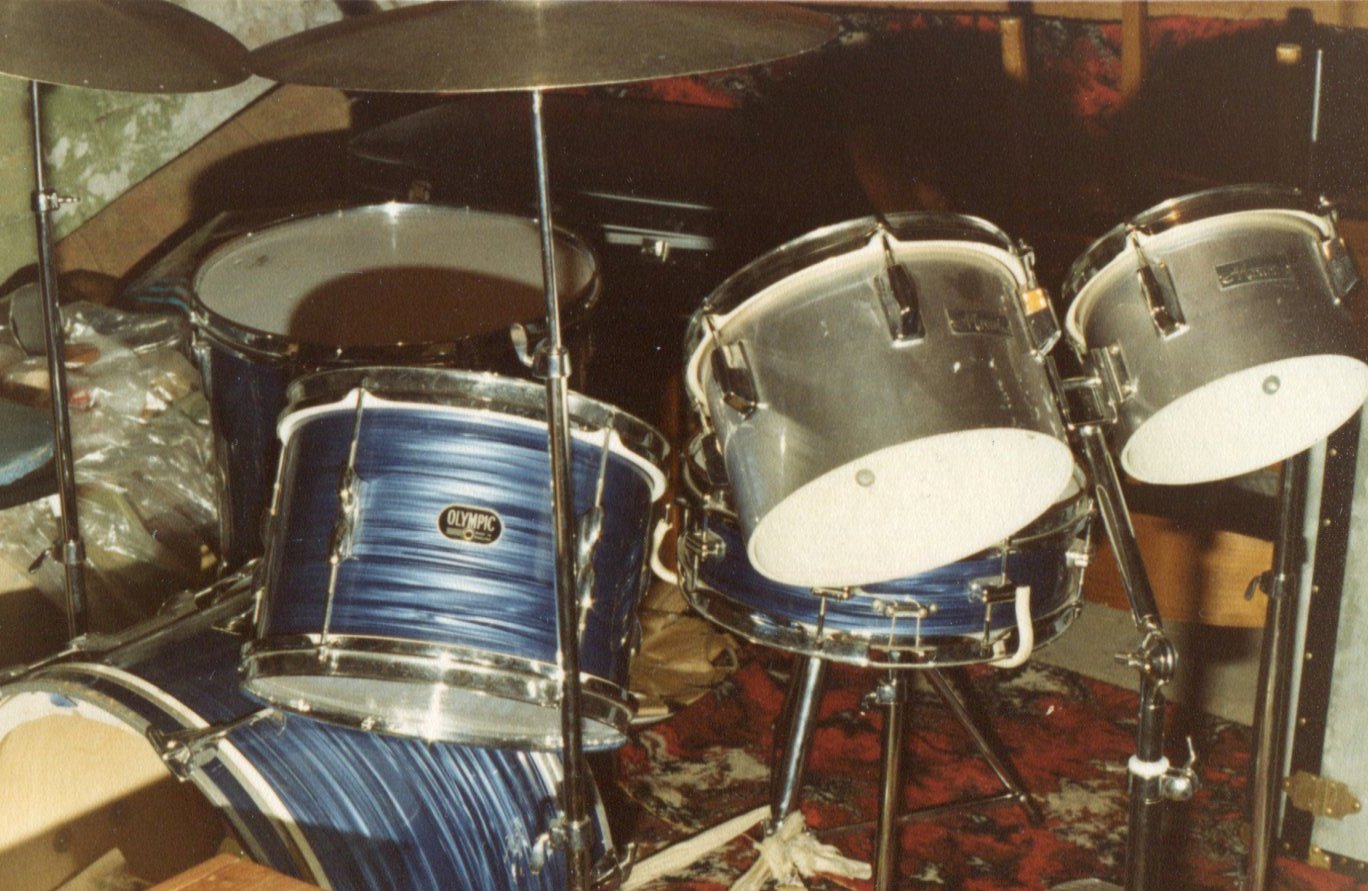
My old 4 piece, 1960's Olympic kit
with additional hanging toms, all in the attic!
Circa 1980.

I had been playing drums since aged 11 and had got my first kit when I was 12. I played mostly rock and roll and pop, but I also played along to a few jazz l.p.'s that were in our house. I would take my record player and amp up to the attic where my blue, 1960's Olympic drum kit was housed, plug in my headphones and bash along to whatever records I took up with me. That was it, right there. At the time I had not played with another musician, unless you counted the time I played in the school band, which I really don't! So we were in this restaurant eating and my dad persuades the pianist to let me play on the drum kit which was there. I was insanely nervous and unprepared. It was not a school audience, but total strangers. I was not performing with peers and friends, but a professional pianist. I had no idea what tunes we were going to play. I think my dad knew the piano player.

Painted Bass Drum, and yes that is a cow bell for a leg!
And the drum sticks are in a Wellington boot!
The pianist asked me for a song I knew and I said, Tiger Rag. I knew this from a live recording of Louis Armstrong and had played it a number of times on my own.  It's a crazy upbeat number, lots of fun. But being jazz, the pianist either played a completely different song, or played a totally different version. Of course, it's jazz! I hung in there. The pianist played another tune and I fell into the music, lost myself to the piano. In storytelling it is called riding the elusive dragon, an image I love and think totally captures the feeling. Some people call it on-form or being on, in the game, or in the moment. It is a place of beauty and magic.

Performing live gives you a high, a buzz, a thrill. But more than that, it connects you with your audience in a way that is unique to performance. You are them, they are you. Some rock musicians say it is better than procreation. I am not sure I can say that is true with storytelling, but it is pretty darn good. This connection is almost spiritual. It connects you with people in ways unlike any other. Ask yourself how you felt after going to a great concert, or what you were feeling after hearing a professional storyteller and were moved in some way by what they were doing.

It turns out we have a similar, quite possibly less intense, experience when we have meaningful conversations. Science had proved there is a very close connection during storytelling. Storytellers and listeners have been hooked up to brain scanners to see how the brain works, and lights up. http://news.sciencemag.org/2010/07/mind-meld-enables-good-conversation Since this 2010 experiment other studies have been done with storytelling. These have shown that the listener and speaker are so in tune with one another that the brain scans show the listener almost anticipates what is going to happen. That is a truly close relationship you're having with a stranger!

Musicians can be seen doing this with each other when jamming. Playing some tune, the guitarist might change accent and rhythm slightly and the drummer and bassist are right on it. Even though it wasn't planned and completely off the cuff, the other musicians felt what was coming and went with that feeling. To the audience it might have sounded rehearsed and well practiced, but it is a spontaneous event of 'magic', if you will. Comedians doing great improv can and do experience these moments. I am sure sports folks also have this moment.

Storytelling has that connection, but instead of with a colleague on the stage, the shared moment is with the listener. Sometimes, when we do our job and the 'planets are aligned', the elusive dragon flies into the space, we jump on its back and ride with the audience, and everyone is transported. Obviously a controlled environment gives the opportunity for this more than a hot and humid room filled with over-heated children, and distracted camp councilors, but it can happen in those places at those times. Then, (under far from perfect circumstances) it is truly magical, it is a magnificent ride with the story. The colours are bright, the smells of the story are strong, and nothing else in the room, or outside the room matters. And later, after the gear is packed up and you're driving home, you know you reached people, and there is that high, buzz, thrill. Maybe you gave the audience a little more joy, maybe more understanding about the world we live in, for all its horrors and hardships. And in those mystical moments we are taken somewhere else, far away and are who we want to be, if only for a moment.
In the moment of joy, July 2015!

Saturday, June 27, 2015

My first engineer and producer - Kristina Stykos

CD cover photo by John Churchman
What feels like a million years ago, but was in fact 2005, I had this crazy idea to record a CD of stories. I had no idea how to do it and wanted to do it right. I asked a few friends, some of whom said: 'do it yourself, you can do that', but I wanted to set the bar high and have no regrets about what I put out as my first foray into the retail world of CDs – while it lasts!

A friend of mine, Rick Barrows told me about Kristina Stykos who going digital and was a recording engineer. I got in contact with her and the rest, as they say, is history. My first CD is still one of my favourites. Kristina did a brilliant job. Recently Kristina released her own fifth, to my knowledge, CD called Horse Thief. I had Ms. Stykos' first CD, In the Earth's Fading Light (2005) and could not quite get into it. I saw and heard a great songwriter and performer, but for me, there was something missing that I could not put my finger on. Whatever it was, is here in bucketfuls on Horse Thief.

Kristina's songwriting skills, both musically and lyrically are top notch. Her word choices are flawless. The sadness in some of the songs (some heart wrenching) is deep, her lyrics are powerful, have meaning and grit behind them. There is humour too. And bounce! I listen to so much music and these days it is hard to find a great beat and tune, catchy as all heck and good lyrics. It seems that either the words are, quite bluntly, shite and the music is good, or the other way around, or it's all crap. But not here. Oh, no, not here. I grew up listening to master song writers from Paul Simon to Elvis Costello, and Stykos hits the mark on Horse Thief, totally!

The album opens with the crackingly good title track resplendent with slide guitar, passionate fiddle and thumping bass and drums, and of course Kristina's voice. I have to say something about her voice. It is all hers. Some voices out there in the ether sound the same as many others, and but a few stand out. As you wind through the songs on Horse Thief you will hear slight traces of Joni Mitchell, Patti Smith and a hint of Marianne Faithful, but it is all Ms. Stykos. Her voice is like a V12 engine, just idling, or cruising along some boardwalk with the wind blowing in your hair. I have not seen Kristina playing live, but will try to, as I want to hear her belt out some song and see what that V12 voice can do!

Photos of Kristina Stykos by Jack Rowell

The second track keeps up the high standard of work (which flows with ease through the whole album) and the music here is complimented with keyboards which I wish there was a little more of. But that's just me – I love the sound Kristina uses on the song and in You'll Never Love Me. The third song, Me, Myself, Moi could have seemed a little out of place, but it is perfectly at home on Horse Thief. For some reason, with no reason, this is one of my favourite tracks. The lyrics are very clever in an unpretentious way. Although a tradition approach to a sort of patter song in it's feel, it is a very topical song with references to our modern digital world:
"I need a 12 step, two step /Quarter sawn fix /Or a savvy zen seduction /I need clickable buttons /And a 1-5 list of simple tips /And how-to instructions." Love it! These are very different lyrics to It's Over where Kristina sings:
"...I threw down my stars /and shouted at the night" - powerful stuff. As If Tears Could Say is one of the most beautiful songs I have heard.

The album jogs along taking you through country, city, and rural Vermont life. This is a great album. Unpretentious, clever, witty, intelligent. Kristina has great insight. The music, played by Stykos (acoustic guitar, banjo, bass, mandola, mandolin and keyboards as well as vocals) is backed up by some great musicians: Bow Thayer, Patrick Ross (the brilliant fiddle in Horse Thief), Alex Abraham, Neal Massa, Steve Mayone, backing vocals on a couple of tracks by Nikki Matheson, and drummers Matt Musty and Jeff Berlin.

The packaging is a treat. I loved album covers when we all used to buy vinyl and some LPs I only bought because of the covers. This might have been one of those albums. The photography throughout the tri-gate digipack and booklet (yes, there is a booklet inside with all the lyrics and players so you can read along!) is stunning and, I think, captures all of Kristina.

I would love to hear an album of Stykos' with more work like the title track. Story songs of floods, old timers, bank robberies, or maple syrup thieves maybe! This album is about love, betrayal and loss, and redemption and done in such a way it is uplifting. I did not want the album to end and when there were some longer pauses after some of the tracks I hoped for more and got it. The 13 titles ends with an instrumental called Remembering and is the perfect ending on a perfect album, like a sigh in the night.

Package designed by Darryl Garland/red-garland.com

Kristina Stykos is a musician and recording engineer/producer. Her websites are:-
For her music: http://www.kristinastykos.com/
and her studio, Pepperbox Studios, which is totally off the grid: http://pepperboxstudio.com/
And you can buy her music at http://www.cdbaby.com/Artist/KristinaStykos

Wednesday, June 24, 2015

What Are You Packing?

It's summer! There is a lot of traveling, visiting places, staying with family, going on vacation, for a lot of people. But not me. Nor many other performers who work with the library systems, helping children retain their reading level, or raise their reading level over the summer months. But traveling means packing whether it's for holidays or performances.

Steve Blunt at Whipple Hall
Photo by Simon Brooks June 2015
Today (24th June, 2015), I saw Steve Blunt performing for my local library at Whipple Hall in New London, New Hampshire (USA). Being colleagues and friends, we had planned for an ice cream after his show, so I helped, with the library staff, get his gear out of the hall and curbside. He had everything but the kitchen sink, so he said. And it certainly looked like it! The back of his car was FULL! This is the start of the Summer Reading Program Season, so, Steve told me, he had everything - Just In Case! Speakers, PA, brass instruments, drums, shakers, djembes, guitar, uke, a microphone or two, a few harmonicas, books, CDs - all sorts of stuff. As he was packing up his kit, it made me think of what I pack.

There is this new phase going round for something as old as pockets! EDC. No, it's not medical. Well, for some it might be! EveryDay Carry. Some storyteller I know carry nothing but the stories in their heads. Some have recorders, like Papa Joe. Others, like Odds Bodkin might be carrying around a harp, and guitar. EDC is what we carry, apparently, everyday. Things which are indispensable, or not, yet things we believe we absolutely need. Most teens these days have their keys and phone and maybe a ten dollar bill which they travel with. Parents have band-aids and boo-boo cream, and wipes or tissues, spare cash and credit cards, and maybe a Leatherman in case of loose teeth. I do! Bikers might have sunglasses, and gloves, toothpicks and combs to get bugs from their beards and teeth! Well, the guys anyway!

Summer, for me, requires a different kit than in winter, simply because of the amount of travel and work I am doing. So, what am I packing this summer?


I have my apple crate which contains:
  • My throne (old, and loved drum stool)
  • Duct tape and gaffer tape (always handy)
  • String (to tie my backdrop to a tree or post, if needed outdoors)
  • A basket for fliers and bookmarks
  • Spare fliers
  • CDs
  • Pens and mostly pencils for the newsletter sign-up
  • Newsletter sign-up sheet
  • My small bag of 'stuff' - mini props
  • Sometimes my singing bowl
  • My notebook of stories (contains lists of what I have told and where, as well as an incomplete list of the stories I tell)
  • My steel water bottle and sometimes an extra
I have my backdrop and its stand
My bodhrán and a number of tippers or sticks
My bull roarer and a couple of finger shakers
A Swiss Army knife (to cut the string, tighten screws on stands and such)

Most often in the summer I also carry my:
  • Powered speaker/PA
  • Speaker stand
  • My mic and a spare
  • A microphone stand
  • Cables, including a spare
  • Spare batteries
  • Spare shirt and undershirt, spare socks and spare sneakers (in the summer, nothing is better, after a couple of hard working gigs, than to slip on a new, cool and dry pair of socks and shoes!)
  • And a CLiF banner!
And everything fits in my trunk/boot, apart from the backdrop which is too long, so sits in the back!

I usually have a point and shoot camera with me in case I see something cool to photograph on the way, if I have time, or on the way between two gigs or on the way back home! Oh, and the camera is there if I remember to ask someone to take photos of me working my trade for possible future website shots!

Sometimes I have my kids with me. Sometimes I don't I don't

So what do are YOU packing this summer?

Tuesday, June 16, 2015

Great children's literature, for adults (summer reading, anyone?)

Kid's cover, UK
I have always read children's books, from picture books to chapter books and juvenile fiction and, occasionally, juvie non-fiction. From when I was a kid, through my teens, to my 20's, you get the idea! When the first Harry Potter book came out I bought a copy from the U.K. where I first came across it. It had a different cover on it from the kid's version. The children's book of The Philosopher's Stone, had a children's cover (see left) but so many adults were reading it in Britain that the publishers put out a copy of the book, sans illustrations and with an adult looking cover on it (see below). I loved the story (and the black & white photo of the steam train which makes me think of the original Ladykillers movie). Harry Potter and the Philosopher's Stone was new and exciting, and well told and well written. Better written, I thought, than some adult books I had recently read.


Adult's cover, UK
A number of years ago, I discovered a writer called Leon Garfield. It was ironic that I discovered this English writer only after I had moved to the United States and already had my own children! How did I miss this? Apparently his first book, Jack Holburn (1964), was written for adults but the publishers asked him to re-write it for a younger audience, which he did. His second novel for young readers, released in 1966, won the Guardian Prize.  I first read his fifth book, Black Jack (1968). After reading this story of a hung murderer who forces a young boy to help him (his life was saved by a pipe the villain had inserted down his own throat prior to his hanging), I read his third novel, Smith (1967) and got hold of other books of Garfield's to read.

Although it's a while since I read the aforementioned books, I have recently re-read Smith (Boston Globe-Horn Book Honor Book, winner of the Phoenix Award, and a Carnegie Honor Book), finishing the book last night after two sittings, and read John Diamond (1980) for the first time last week. If you or your teens are looking for a bloody good read this summer, then I ask that you give Leon Garfield a try. Some libraries still have his books, they were re-issued, very wisely, by Sunburst Books, Farrar, Straus, Giroux in 2000, and on looking around the web, it appears they were re-re-released in 2013 by New York Review Children's Collection.

Cover by Brett Helquist, 2000
Garfield's writing is wonderful. The language he uses in Black Jack is deliciously rich. I don't often, or like to call writers storytellers, but really Garfield is. The choice of his words creates an atmosphere for the story to hang in, much the same way a set designer will create a scene for a play or movie; Garfield's words allow your mind to see what he saw when writing. His descriptions taste like honey as they move over your tongue. His dialogue is biting, witty, pithy, caring, loving - depending on who is speaking. The pacing of his books is incredible. Relentless, action-packed, but never rushed. You are given rests, breathers where you can relax and take in what happened before Garfield leads you willingly on to the next part of the adventure. You begin to love even the darkest of characters as he shows their depth and detail. His characters are not two dimensional  so often found in modern fiction, but characters, who, within the first few pages, grab. You want to understand and see these people, who you want to meet to get to know better long after the book is over. Some of the characters you least expect, or maybe you do really, show an unexpected side which shocks you!

Smith is a 12 year old pick pocket, who sees his last victim murdered immediately after he has lifted, not money, but a document. Smith cannot read, and being part of the lower life of London, finds it hard to trust anyone to read it for him so as to know it's value. Soon he finds that he is being hunted down for the document, and his life is in danger. The sisters who he lives with are seamstresses trying to survive on what they make. Smith's best friend is a highwayman who knew and learned from the infamous Dick Turpin. But everyone he has contact with is put in danger.

If you are looking for a book to read over the summer for yourself or your teenager, or something to read together, do yourself a favour and grab one of Garfield's books. Try Smith, or Black Jack to start with, and see if, like me, you cannot put his books down, and find yourself reaching for another! Tonight I will begin Jack Holburn. It looks like there might be pirates in this one!
Can't wait!


Wednesday, May 27, 2015

Stories for Bedtime

One of my family of fans came up with a wonderful name for my bedtime stories CD: "Firefly Light." How wonderful is that? If you had a favourite bedtime story, what was it? One of my favourites, as an older child, was the story of Gelert, the faithful hound.  Wales was not that far from home and my Dad lived in South Wales, so as a family we were often crossing the borders. Many Welsh tales were heard, picked up and told, or read to us and although the story is one of hasty decisions and grief, it is nevertheless a remarkable tale.

Another favourite of mine was a book by a writer/illustrator called Cam. The book, one of several of Cam's was called "Timothy Tabby Cat" from 1947. It is beautifully illustrated as all Cam's books are. I think what caught me were the illustrations which brought the story together. The pictures made up for what might be hinted at in the words. And the dragon was amazing. I have never been able to find out who Cam was, or is. These books were my mothers books, so Cam would be one of our elders by now. Do you have any illustrators or writers who vanished, as it were? Kids writers, I mean.

I think Cam awoke a love of illustration for me. When I have purchased books either for myself in my 20's and 30's or for my kids since they came into the world, or the kids of others, illustration plays a large part in my choices. When I came over to the States I discovered Trina Schart Hyman, who sadly lost her life to cancer in 2004. I was lucky enough to meet her, but at the time I did not know 'who she was'; she was introduced as Trina and I did not make the connection. Trina's work is simply amazing. Cam started the height of my bar, then my friend in England, Rob Brookes raised it, and Trina is one of the greats, in my opinion, illustrating over 150 books.

I would love some comments on your favourite books and illustrators as a child and why, if you have time!

Tuesday, March 31, 2015

William Tell

First of all there's that joke - the sign of an intellect is one who can listen to the William Tell Overture without thinking of the Lone Ranger. But seriously, the story of William Tell is one of freedom, rising up against an oppressor and people standing up for what they believe in.

Most of us know the story of the apple on the head of his son's head, but how many of us remember 'why'? I had forgotten. It's been a while since I read the story at school. So why did William have to shoot the apple off his son's head? Herman Gessler came over from Austria on behalf of the Duke who wanted to take control, allegedly, of the Gottherd Pass and therefore the trans-Alpine trade route. Gessler was commanded to make life miserable for the Swiss who lived in the Cantons of Uri, Schwyz and Walden. He did a very good job, getting the people of those Cantons to reach a level of rebellion. The plan was to upset the natives, giving the Duke the "reason" to invade legitimately and take control.

No large change is made by a single person, but usually a change begins with one individual and they become a symbol of that change. And this is how I see William Tell. Gessler stuck a hat on a pike in the center of Altdorf, and tells the people there that they are to bow to hat as if it is the Duke himself standing there, if they pass it. Of course people avoid going near it as they move through the town refusing to buckle under the Austrian tyranny of the time. William, visiting his father-in-law with his son either does not know, or decides to ignore the order and plead ignorant about bowing. He strolls by without bending his knee, and the soldiers set to guard the hat stop him. Gessler, as it happens, is coming through town as this occurs and wants to know why this man will not bow. When Gessler discovers it is Tell, a renown archer, he says he will let him free, if he can shoot an arrow from the head of his son. The son does not worry as he is taken, we are told, to be bound to a tree. William Tell takes two bolt-arrows from his quiver and puts one in his belt, the other in his cross bow. As we all know he splits the apple and he is free to go, but Gessler wants to know why the second bolt. At first Tell will not share the truth, saying it was force of habit, but then admits it was for Gessler should he have missed his mark. And the story goes on.

This is the beginning of the uprising. Tell is arrested, escapes and the rebellion overthrows the Austrian rulers. The Duke is too busy to come to Switzerland himself as he has other more pressing issues with France and some other countries, if I have read correctly, and ends up dead, leaving the Swizz to continue as they had.

Doing research for this story was great. There is much more to it than I have written here, and as I continue to work on the story, I need to figure out whether to include all the other wonderful parts of the story to tell, or to keep it down to the apple. Personally, I would like to tell the 'whole' story of Tell and the overthrow of the Austrians, but it will not be a short one! I have leaned about the Cantons, or regions of Switzerland. I wonder about the word Swizz and the region of Schwyz and if there is a connection? I found the region where the story unfolds and followed the shapes of the waters where some of the action takes place. I looked at photographs of the area, and of course, it is beautiful. I looked at the dress people wore in the 1300's. There are many paintings of those in high society, and few paintings I could find of those in the peasantry. (I am still not sure what the photo from the movie Carrie was doing amongst the others I was looking at on-line! Definitely not 1300!)

The weapons of the age which would have been used and how the cross bow was high tech. I think of today's drones and how much talk there is about those now. I think of the tyranny that still goes on, the power hungry, the greed, and the lack of compassion for those in need that still prevails. But William Tell is a great tale and one I will be sharing this summer, if everything goes well!

Tuesday, March 03, 2015