Showing posts with label music. Show all posts

Monday, March 07, 2016

Watching people on devices

This is somewhat about story. It's part of my story. From a long time ago!


I have never really been into video games. Ever. To me Pong was interesting to play once or twice; by the time the Sinclair was set up with the tape machine, I was bored and ready for something else other than staring at a screen. I was never still for long growing up. Now I look around and it seems everyone has their heads facing down at a device.

I was talking to someone who seemed to me, spending a lot of time just racing and crashing a car on their phone. I told them that we did not have that sort of distraction when I was a kid - in the UK we had three channels, or stations to watch on the telly, and at 11pm (well, maybe a little later than that when I was a young whipper-snapper) they would shut down and a picture of the Queen appeared and the National Anthem played. And my Grandad always stood up when he heard it. Then t.v. ran later at night, then all through the night and we got Channel 4! The fourth t.v. station! Two (BBC1 and BBC2) were commercial free. So we had that, the movies, and playing for what we would do. I remember making a tube radio set. It wasn't very good, but I made it and at the time it was a sort of magic. We made forts. We made a go-cart and raced it with the one my step-dad had. I think that spurned a couple more on the street. My step-dad had a rel-to-reel Grundig tape machine which my brother Colin and I would play with for hours pretending to be police, or radio d.j.'s. When someone got a new bike on our street, we all rode it. That's how I got the chip on my two top front teeth (another story for another day). We walked everywhere, or I ran everywhere, and when it was too far to run, I would ride my bike or take the bus.
Forts and go-karts

I got to thinking about what I did on my own. I wrote stories. None from those early years are still around. Same with the first poetry I wrote. I would go on these clean-ups and thrown anything out I thought was rubbish. Apparently I thought most of it was rubbish, and probably was! But I would also draw and paint, and make things. I played the drums and fantasized about being in a famous rock band. I wanted the band to be mine. I came up with titles for songs and write sleeve notes about the songs. Then I would SOMETIMES write the lyrics to these imaginary songs. Then I worked with some musicians and we put music to some of the lyrics. I would also make fake album covers. I still have a few of them, and some other pieces of art which were concepts for these fake albums.

I was talking to my son about time being lost playing video games. They are fun, and they are stimulating, but there is nothing to show for it, apart, maybe, a score on the web which shows your best game, and rarely people know, or care, who you are. I pulled out one of my double album gate-fold covers  I had made - one of my fake album covers. (Yep, I did a daddy thing!) It was for a real band with real people - my friends and my brother. The band was short lived, but quite good and was called Grover Bass (as in base, or bass guitar). We never made it into a studio, and I think we played, in that incarnation about twice! But that's not my point.

With a 35mm Yashica camera (or maybe by then it was the Pentax Spotmatic), some Letraset (letter transfers - each letter painstakingly placed and transferred from the film to its its proper place, or rubbed out and done again), a photostat camera, an old typewriter, and scissors and glue, after a few prototypes I created this:
  
The front cover and...


The back cover
Yes, the chap in the white shirt at the front of the very top photograph is the same young man on the front cover - my brother, the latter photo taken around 1983. This work, to me, was something I loved to do - create. I loved my camera and taking photos and processing the films and printing in our cold cellar. It wasn't until I went to college when the art of printing came easy to me - it clicked one day, and I could print! And there was something I had created, something I had made. It was not just me, but other people around me were doing the same thing. Painting, pottery, writing plays, songs, poetry and stories. Creating.

Playing games on devices is fun, but you don't get time back. There is nothing added to your existence, or to the existence around you. You learn nothing but reflexes and hand-eye coordination. I have some mediocre artwork which I quite like (the inner photos of the gate-fold were not all that great!) which I made with friends and family. I can still hold it in my hand and show my kids. My son went and dove into his sketch book. I smiled.


There are still some songs/poems I have not written yet from the titles on this album cover. One day I might have them done!

Saturday, August 01, 2015

LIVE! And in the moment.

Practicing, circa 1980

There is something special about performing. My first exposure, like most peoples, was in the school play, or first school musical presentation, but back then I was still learning my craft, insanely nervous, or just goofing around with friends, and not in the moment. My first real taste of that something special was when I was 14 or 15 and my dad had me sit in on drums with a jazz pianist at a restaurant we were at. My parents had divorced when I was 6 and I only got to see my dad at holiday time - Christmas, Easter, the summer holidays, etc.. Of course I wanted to show Dad what I could do. He never got to hear me play.
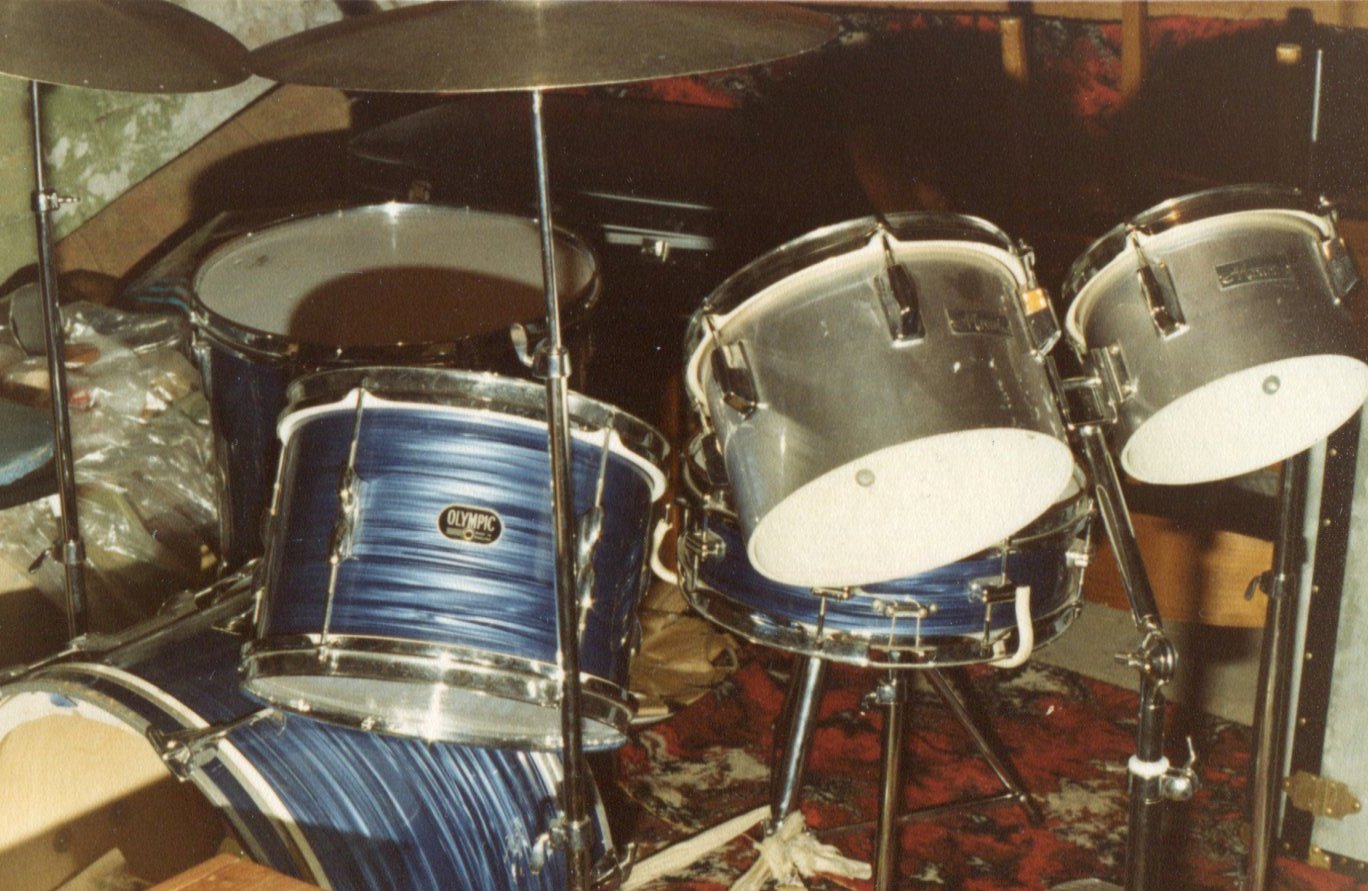
My old 4 piece, 1960's Olympic kit
with additional hanging toms, all in the attic!
Circa 1980.

I had been playing drums since aged 11 and had got my first kit when I was 12. I played mostly rock and roll and pop, but I also played along to a few jazz l.p.'s that were in our house. I would take my record player and amp up to the attic where my blue, 1960's Olympic drum kit was housed, plug in my headphones and bash along to whatever records I took up with me. That was it, right there. At the time I had not played with another musician, unless you counted the time I played in the school band, which I really don't! So we were in this restaurant eating and my dad persuades the pianist to let me play on the drum kit which was there. I was insanely nervous and unprepared. It was not a school audience, but total strangers. I was not performing with peers and friends, but a professional pianist. I had no idea what tunes we were going to play. I think my dad knew the piano player.

Painted Bass Drum, and yes that is a cow bell for a leg!
And the drum sticks are in a Wellington boot!
The pianist asked me for a song I knew and I said, Tiger Rag. I knew this from a live recording of Louis Armstrong and had played it a number of times on my own.  It's a crazy upbeat number, lots of fun. But being jazz, the pianist either played a completely different song, or played a totally different version. Of course, it's jazz! I hung in there. The pianist played another tune and I fell into the music, lost myself to the piano. In storytelling it is called riding the elusive dragon, an image I love and think totally captures the feeling. Some people call it on-form or being on, in the game, or in the moment. It is a place of beauty and magic.

Performing live gives you a high, a buzz, a thrill. But more than that, it connects you with your audience in a way that is unique to performance. You are them, they are you. Some rock musicians say it is better than procreation. I am not sure I can say that is true with storytelling, but it is pretty darn good. This connection is almost spiritual. It connects you with people in ways unlike any other. Ask yourself how you felt after going to a great concert, or what you were feeling after hearing a professional storyteller and were moved in some way by what they were doing.

It turns out we have a similar, quite possibly less intense, experience when we have meaningful conversations. Science had proved there is a very close connection during storytelling. Storytellers and listeners have been hooked up to brain scanners to see how the brain works, and lights up. http://news.sciencemag.org/2010/07/mind-meld-enables-good-conversation Since this 2010 experiment other studies have been done with storytelling. These have shown that the listener and speaker are so in tune with one another that the brain scans show the listener almost anticipates what is going to happen. That is a truly close relationship you're having with a stranger!

Musicians can be seen doing this with each other when jamming. Playing some tune, the guitarist might change accent and rhythm slightly and the drummer and bassist are right on it. Even though it wasn't planned and completely off the cuff, the other musicians felt what was coming and went with that feeling. To the audience it might have sounded rehearsed and well practiced, but it is a spontaneous event of 'magic', if you will. Comedians doing great improv can and do experience these moments. I am sure sports folks also have this moment.

Storytelling has that connection, but instead of with a colleague on the stage, the shared moment is with the listener. Sometimes, when we do our job and the 'planets are aligned', the elusive dragon flies into the space, we jump on its back and ride with the audience, and everyone is transported. Obviously a controlled environment gives the opportunity for this more than a hot and humid room filled with over-heated children, and distracted camp councilors, but it can happen in those places at those times. Then, (under far from perfect circumstances) it is truly magical, it is a magnificent ride with the story. The colours are bright, the smells of the story are strong, and nothing else in the room, or outside the room matters. And later, after the gear is packed up and you're driving home, you know you reached people, and there is that high, buzz, thrill. Maybe you gave the audience a little more joy, maybe more understanding about the world we live in, for all its horrors and hardships. And in those mystical moments we are taken somewhere else, far away and are who we want to be, if only for a moment.
In the moment of joy, July 2015!

Monday, February 25, 2013

Music and Story

One of my favourite albums!
I have just finished reading a book by Nick Hornby (High Fidelity, About a Boy, Fever Pitch and A Long Way Down amongst others) called Songbook.  Although it is primarily about his top favourite pop songs, it talks about the importance of music and in particular pop music.  He defines pop as most things which have a three verses and a chorus and comes in at around 3 or 4 minutes, with the occasional exception.  I also have a friend called Stevens Blanchard who has his very own pop group called Conniption Fits, as many in the Upper Valley of NH and VT will know.  He is also a D.J. (an acronym for disc jockey, someone who jockeys discs - nowadays CDs! I resent the words deejay and emcee.  Is a deejay a type of bird?  I have no idea what an emcee is, but I know that M.C. stands for Master of Ceremonies)! He says that country is the new pop! Anyway! Hornby writes about there was only 'one type of pop', but now there are many sub-divisions of pop - such as heavy metal, hip-hop, death metal, punk, R&B, soul, etc and even country and western (both kinds!), but it got me thinking about storytelling.

So, my thoughts: classical music was the 'pop' of the age, then came along those flappers listening to Gershwin, Armstrong and Bessie Smith and later: Crosby, Sinatra, Connif, and Streisand who shocked everyone at the time.  And ?!  And then they became pop. Then rock & roll came to be and everyone had to lock up their daughters, and ban r 'n' r as devils music.  Then rock & roll turned into pop.  Rock & rock became heavy or hard rock, and then heavy metal and daughters were again locked up. Then punk arrived and all children were kept safely at home, but that too turned into pop. Get the idea?

So here was aural storytelling, which began trying to explain the universe, then along came the legends, stories of real people which merged with other people and became surreal and mixed with magic.  And like the first pop, that stayed around for a long time.  A shake up was overdue, like an old library book, and people (I believe mostly Americans) 'launched' the personal story genre into the arena of public storytelling.  Once personal stories were added to the cache of storytelling genres, a punk movement (which in England was regarded as a political movement) was needed and we got story slams.  Or maybe slams are a story version of a combined punk and rap movement. Big stories made short with great economy of words, but with none of the passion lost.

And another of my faves.
All of this, of course, does not take in account that the original political advisers to the kingdom rulers were the poets and singers of the pre-Christian era.  The first Romans to Britain found schools larger than any today and wrote about these colleges as being filled with budding bards, so were the stories were first sung? In John Matthews' Taliesin, he quotes that a bard had to learn in their first year 'fifty oghams or alphabets. Elementary grammar. Twenty tales.'  In their sixth year, they learned 'the secret language of the poets. Forty-eight poems of the species called Nuath. Seventy or eighty tales.'  In their twelfth, yes I said twelfth year they go on to learn '120 Cetals or orations. The Four Acts of Poetry. During the three years to master 175 tales [in their ninth year!] in all, along with the 175 Anruth, 350 Tales in all.'  As Matthews says: 'R.A.S. Macalister writes: Suppose ... [we] keep them in school 300 working days in a solar year ...they learn no more than ten lines of poetry in a day, they will have acquired a total of 3,000 by the end of the year, and in twenty years they will be masters of 60,000 lines.  This is considerably more than twice the length of the two Homeric epics.'  I am assuming here he is saying that those epics would be memorized word for word!

Can you imagine a pop star doing this?  Granted there are some storytellers who do tell the Odessesy, and Gilgamesh, and other epics, but the rest of us?  I try hard to learn at least ten new stories a year.  It usually ends up being five or six, but still!

Taliesin - my logo
So what is my point?  As Nick Hornby says in his book, he needed the Clash in his teens, and all other music to his ears was sappy, or spineless, but now he looks for more in music than what the Clash has, now, to offer him.  As a huge Clash fan myself I feel a little resentment to his words, but the sentiment I agree with.  He has not 'gone over to jazz' yet, but then I was into jazz in my teens.  As a storyteller I am finding that the tales I tell have become deeper, that they are tales I tell are less for entertainment, but for the stories themselves.  As more and more slams happen, and they loose their punk/rap/hip-hop counter culture status and become pop, will these listeners begin to seek out the storytellers who are the Orffs, Bachs and Elgars, or the Fitzgeralds, Silvers, and Monks?  This was not quite what Hornby was saying, but it is what he inspired in my own mind and made me wonder the reflection of pop songs to storytelling.

Maybe I should look at that course at East Tennessee on storytelling and folk lore!  Maybe I would find my inner Clash storyteller, or might I find that I am now more Mingus or Mozart? Only time will tell!