Showing posts with label drums. Show all posts

Tuesday, May 03, 2016

Becoming a storyteller - Beginning and beginners


I'm the one in green tights getting ready to be Peter Pan!
My mother says I came out of the womb telling stories. I wrote stories all through my teens and in to adulthood and still do. When I began telling stories to strangers and non-family members in 1990 at Youth Hostels on the South Coast of England, most were my own written tales. I learned a few folk tales, and fairy tales and told those too. Then a school group took me to a storytelling presentation by Eric Maddern in Battle, Sussex where the Battle of Hastings took place in 1066. Eric brought history to life to everyone there. It was brilliant. So brilliant I bought a three tape cassette pack of his Stories in Historical Places. I still have it. Eric Maddern opened the door to storytelling for me and was to a degree, my first inspiration in that direction. And then I bought Northern Lights, stories,myths and sagas by Kevin Crossley-Holland. He too, was another great inspiration to me with storytelling. I was in love with the old traditional stories.

Avebury, England © Simon Brooks 2016

A few years later, I crossed the Atlantic and a good few years after that, in 2003 I got a job as a children's librarian in Thetford, Vermont.  I told stories again to non-family members and children of stranger and not friends!  The mommy circuit spread my name to other libraries and the dozen stories I told became too small a repertoire. So I began learning new stories.

For me, telling tales to kids was easy, but then every once in a while we would do a community event and I would tell tales to kids and grown ups and I got very nervous.  At first I would have a cheat sheet, or crib sheet near me that I could glance at it if needed.  Then I would break stories down to their main bullet points, reduce them to an essence and tell from those bullet points. And then I was told about Odds Bodkin and got to see him.  He made noises, sound effects, and great character voices.  This was a first for me.  He became my third inspiration and opened a new door for me.  I already used voices, but sound effects!  When I read to kids I used sound effects and voices, especially with my own kids, but never when I told stories.  Odds Bodkin 'gave me permission' to try something new with my storytelling and I took to it with gusto! A new dimension was added to my tales. The stories became more alive for me in my mind and that reflected outward to the audience who also came into the stories with me more easily and more willingly.


When I met Eric Maddern, he was standing telling his tales to a large group.  He might have used a couple of sound aids, in the form of a bull roarer, and maybe bells.  He did straight telling and when I later read the picture books he published, I could hear his voice telling them in his soft lyrical, yet powerful manner.  I still love listening to his tapes, which I was able to digitize, as do my kids.

When I heard Odds for the first time, he was all out - go-and-get-'um type of thing. But he softened his 'attack' with the instruments he used (harp and acoustic guitar), which lulled us as he spoke.  I also got hold of recordings of Jim Wiess who told in a soft gentle manner, occasionally using guitar.  His style made you feel you were sitting all cozy in a room, drinking hot chocolate with the kids on his lap. Odds was the only one, really, to use character voices and vocal sound effects.  The actor and mimic within me liked that, and as I was already reading to kids like that, had told stories and jokes since school like that, so it was a great step to make and very natural for me.

Some tellers use character voices and some do not.  Some use musical instruments, some do not. Some stand or sit and tell with their voice, some, like me bounce all over the place. I did not use musical instruments, as I only played the drums and taking a full kit to a storytelling performance would not work. I could not play guitar, or any other stringed instrument and my harmonica had rusted up, along with the very little skill I had of playing it. I decided to buy a bodhrán.  I did not know how to play it, but figured it could not be too hard as I was a drummer.


I bought a cheap drum, in case I did not like it, or decided not to go with it.  It took three days to learn how to play a steady beat, torture for all in my house at the time. I am still learning new ways of playing it today, more than six years later. I now have a very nice bodhrán! I can play it quite well with and without other musicians! When I set up and people are coming in and before I am introduced, I can pat away on my bodhrán and it helps get me into story space and takes my mind off the audience. It allows me to go to a place in my mind where the stories live and wait to be told, or jump out demanding to be told!

After I heard Odds Bodkin a few times, I thought I would never be as good as he is at telling stories. But then I realized I didn't have to be as good as he is, I needed to be as good as I could be. I had to be the best Simon Brooks I could be. Everyone has their very own style and voice. Sometimes when you start to learn anything new, you mimic those you love, those you read, listen to, etc.. But after a while you find your own voice. This goes for singers, musicians, writers everyone.

Me and Papa Joe

You might use a musical instrument, you might not. You might use character voices, you might not. You may jump about like a maniac on the stage, you might not. You might use mime, you might not. You will do what feels right for YOU. You will do what you do best. What you don't do best, you should drop like a hot brick. Or work at it, until you have it perfected. Or not.

The most important thing to do though, the two most important things you should do are:
1/. Tell stories that you LOVE. That will come over to the audience when you tell a tale. It comes across if you don't really love the tale too!
2/. Have fun with it. If you have fun, so will everyone else.

Oh, and a third thing: Don't beat yourself up if you make a mistake. We all make mistakes (even the very famous ones!). Those of us who have been doing this for a while cover it up well and you will too.

Peace,
Simon

Saturday, August 01, 2015

LIVE! And in the moment.

Practicing, circa 1980

There is something special about performing. My first exposure, like most peoples, was in the school play, or first school musical presentation, but back then I was still learning my craft, insanely nervous, or just goofing around with friends, and not in the moment. My first real taste of that something special was when I was 14 or 15 and my dad had me sit in on drums with a jazz pianist at a restaurant we were at. My parents had divorced when I was 6 and I only got to see my dad at holiday time - Christmas, Easter, the summer holidays, etc.. Of course I wanted to show Dad what I could do. He never got to hear me play.
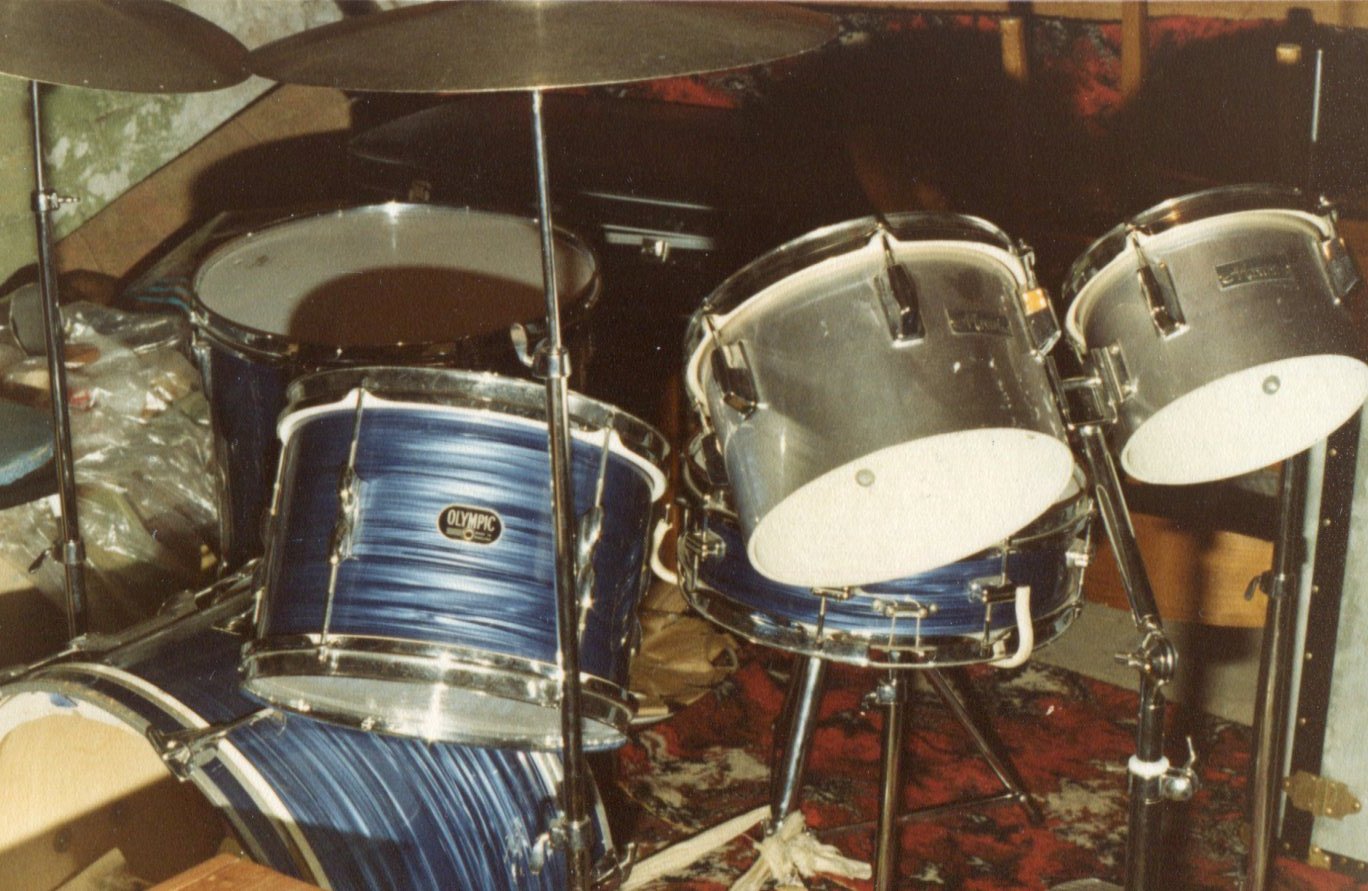
My old 4 piece, 1960's Olympic kit
with additional hanging toms, all in the attic!
Circa 1980.

I had been playing drums since aged 11 and had got my first kit when I was 12. I played mostly rock and roll and pop, but I also played along to a few jazz l.p.'s that were in our house. I would take my record player and amp up to the attic where my blue, 1960's Olympic drum kit was housed, plug in my headphones and bash along to whatever records I took up with me. That was it, right there. At the time I had not played with another musician, unless you counted the time I played in the school band, which I really don't! So we were in this restaurant eating and my dad persuades the pianist to let me play on the drum kit which was there. I was insanely nervous and unprepared. It was not a school audience, but total strangers. I was not performing with peers and friends, but a professional pianist. I had no idea what tunes we were going to play. I think my dad knew the piano player.

Painted Bass Drum, and yes that is a cow bell for a leg!
And the drum sticks are in a Wellington boot!
The pianist asked me for a song I knew and I said, Tiger Rag. I knew this from a live recording of Louis Armstrong and had played it a number of times on my own.  It's a crazy upbeat number, lots of fun. But being jazz, the pianist either played a completely different song, or played a totally different version. Of course, it's jazz! I hung in there. The pianist played another tune and I fell into the music, lost myself to the piano. In storytelling it is called riding the elusive dragon, an image I love and think totally captures the feeling. Some people call it on-form or being on, in the game, or in the moment. It is a place of beauty and magic.

Performing live gives you a high, a buzz, a thrill. But more than that, it connects you with your audience in a way that is unique to performance. You are them, they are you. Some rock musicians say it is better than procreation. I am not sure I can say that is true with storytelling, but it is pretty darn good. This connection is almost spiritual. It connects you with people in ways unlike any other. Ask yourself how you felt after going to a great concert, or what you were feeling after hearing a professional storyteller and were moved in some way by what they were doing.

It turns out we have a similar, quite possibly less intense, experience when we have meaningful conversations. Science had proved there is a very close connection during storytelling. Storytellers and listeners have been hooked up to brain scanners to see how the brain works, and lights up. http://news.sciencemag.org/2010/07/mind-meld-enables-good-conversation Since this 2010 experiment other studies have been done with storytelling. These have shown that the listener and speaker are so in tune with one another that the brain scans show the listener almost anticipates what is going to happen. That is a truly close relationship you're having with a stranger!

Musicians can be seen doing this with each other when jamming. Playing some tune, the guitarist might change accent and rhythm slightly and the drummer and bassist are right on it. Even though it wasn't planned and completely off the cuff, the other musicians felt what was coming and went with that feeling. To the audience it might have sounded rehearsed and well practiced, but it is a spontaneous event of 'magic', if you will. Comedians doing great improv can and do experience these moments. I am sure sports folks also have this moment.

Storytelling has that connection, but instead of with a colleague on the stage, the shared moment is with the listener. Sometimes, when we do our job and the 'planets are aligned', the elusive dragon flies into the space, we jump on its back and ride with the audience, and everyone is transported. Obviously a controlled environment gives the opportunity for this more than a hot and humid room filled with over-heated children, and distracted camp councilors, but it can happen in those places at those times. Then, (under far from perfect circumstances) it is truly magical, it is a magnificent ride with the story. The colours are bright, the smells of the story are strong, and nothing else in the room, or outside the room matters. And later, after the gear is packed up and you're driving home, you know you reached people, and there is that high, buzz, thrill. Maybe you gave the audience a little more joy, maybe more understanding about the world we live in, for all its horrors and hardships. And in those mystical moments we are taken somewhere else, far away and are who we want to be, if only for a moment.
In the moment of joy, July 2015!