Showing posts with label live performance. Show all posts

Wednesday, March 20, 2019

Why Sound is Important

I have met a number of people who are weary of microphones, PA systems, and the like. I get comments like - too many cables, not sure where they go, what does it all do! I get it. The first time I saw a sound board I was a little "awestruck!" Meeting so many storytellers who are not comfortable with sound systems I decided to offer a workshop and from that grew a small booklet - a basic 'how-to' on the whats, wheres and why-fores of sound in relation to performance, in particular to voice work.

Sound is important in our job as storytellers. It is, for the most part, an oral art form for an aural audience.  Obviously, this is not always the case. There are amazing storytellers who are deaf and use sign language, there are storytellers who use tell tales using a digital format, but for the rest, it is our voices that do The Job.
In an ideal setting we would never need amplification. In an ideal setting we could use our ‘indoor’ voices and everyone would hear. We would never get sore throats, or infections. We would all instinctively know the best way to use our voices to maximum effect with minimum effort. But this is not the case. The hall is massive and our voice is lost or echoes so much there is an eerie delay, the wind takes our voice, or the acoustics are so bad people whispering at the back are as loud as you are annunciating and articulating with your best projection from the front! Sometimes we need amplification.


In my youth I was in a number of bands and always into the equipment side of things: the mixing boards, the microphones, and speakers, both in and out of the studio; even though I was ‘just a drummer’ and never had the voice to sing outside of a shower or car! I discovered that different voices did not always sound good on the same microphone. Some mics were okay all round microphones, but some mics worked well for one singer and another mic worked better for a different vocalist. Guitarists choose amps to project a certain sound or feel. Drummers use different skins, have kit and cymbal manufacturers they preferred over others.
As a storyteller I was able to bring all this knowledge with me, and when I got ‘kitted up’ for larger performance spaces and for venues where the acoustics were lavatory quality, I knew what to do. (All my old equipment was left in the UK and sold, or given away over 20 years ago.) I tried out a number of microphones when I recorded my first CD as I know my voice has a strong sibilant side. For fun, I tried out the most expensive mic the studio (Pepperbox Studios in Vermont) had in their collection. My voice sounded scratchy, and hissing to the point it might make one wince. The mic sounded great on someone, just not me! I tried out a few other microphones and found one that cut the sibilance down and brought a slightly deeper resonance to the mix. That mic I liked a lot. It is the same with speakers. They have their own ‘colour’.
Our art requires us to be heard and understood. As storytellers we need to have equipment which allows us, even in the most horrendous of situations, to be clear as a bell, to be heard over traffic, wind, heating/cooling systems, or rude patrons, amongst other handicaps. As professionals we need to be aware of what is available, what makes us sound good or bad, and most importantly how to set equipment, and a room up for success. We display our professionalism and that we are worth our salt. We show we know what we are doing. People then know we take our profession seriously. It shows our customers, be they libraries, museums, businesses, theatres, etc. that we can be trusted to do a great job and that we can be hired again, and that means more work for all of us.
We want an audience to go home having felt they were in an intimate setting, having an intimate experience, no matter the size of venue, or number of bums on seats. Maybe we get the room set up so perfectly, they leave not even realizing there was amplification. We need to know how to amplify a room for ourselves. Finding and using the right equipment properly is so important. As I implied, and can confirm, the equipment does not have to be the most expensive. But it does have to be right - for us, as individuals.
Why Sound Matters by Simon Brooks, © 2016

Wednesday, March 30, 2016

Is Older Better?


Raven, artwork by Simon Brooks
 © 2016
I'm not talking about me here! I'm talking stories!
There is much stress is made on the Greek Myths in education.  I suppose there is very good cause for this.  Many of the places in these tales are real places and can be traced and taught. But there are so many other cultures whose myths and stories we should be exploring and sharing.  After my own cultural mythology of the Norse Gods, I discovered the Native American stories. They really spoke to me on a deep, deep level.  And I have found the same with Chinese and Indian (Asia) tales.  Much of this I want to explore and research more.

The Old Tales were for grown ups, not children. Let's face it, Grimm's stories contain infanticide, murder, theft, cannibalism, and yet more murder, as do many folktales from other cultures.  Look at the Baba Yaga stories, and some of Australia's traditional stories. In Australia there are tales where babies are eaten, of people setting fire to each other and the animals killing each other in horrific ways.  Many European stories have been watered down over the years, more recently and heavy-handedly in the last 40 years.

I think the stories from former Eastern Block countries were able to keep their strength and power, as they were less touched, as it were, by the French Romanticism and the Victorian era idea of cleaning everything up prim and proper! Some of these are not tales to tell or read to children, at bedtime or other times! But they are great for adults. It irks me a little that the Norse and Germanic pantheon of myths are often overlooked.  Huge units are taught on the Greek Myths, why not the Norse Myths and Sagas? Why not the Indian and Buddhist, Hindu tales too?  I have nothing against the Greek myths, although if children were taught the full story of Zeus and his philandering, the tricks he played in spite, and fear of wrath from his wife Hera, they may have a little less respect for these gods. And Hera always took out her revenge on the innocent, who Zeus had already mistreated!  The Norse gods always held themselves accountable, they seem like real people - "oops, messed up there!"  Very human.


I love the older versions of the Old Stories and take great pleasure from sharing them.  They are so strong. The messages strike harder and deeper.  I love telling these stories.  With all the personal stories being told and being listened to on The Moth and the like, there seem to be few kindred spirits in telling folk tales for adults.  I think if people took the time to sit and listen to the Old Stories we would find a medium in storytelling that is more intimate than theatre, more powerful than the movies and just as healing at times as a much needed call to your parents, trip to the therapist, or a snuggle with your Gran!  As Cassandra Cushing put it in the Bay Express on-line: "...part of the appeal of these stories is how they provide more concrete and straightforward ways for thinking about life's complications."

If you want to explore some of these tales, check out my beginners list of books on folk and fairy tales, myths and legends by clicking here: http://www.diamondscree.com/Booklist.htm
Enjoy!
Simon

Saturday, August 01, 2015

LIVE! And in the moment.

Practicing, circa 1980

There is something special about performing. My first exposure, like most peoples, was in the school play, or first school musical presentation, but back then I was still learning my craft, insanely nervous, or just goofing around with friends, and not in the moment. My first real taste of that something special was when I was 14 or 15 and my dad had me sit in on drums with a jazz pianist at a restaurant we were at. My parents had divorced when I was 6 and I only got to see my dad at holiday time - Christmas, Easter, the summer holidays, etc.. Of course I wanted to show Dad what I could do. He never got to hear me play.
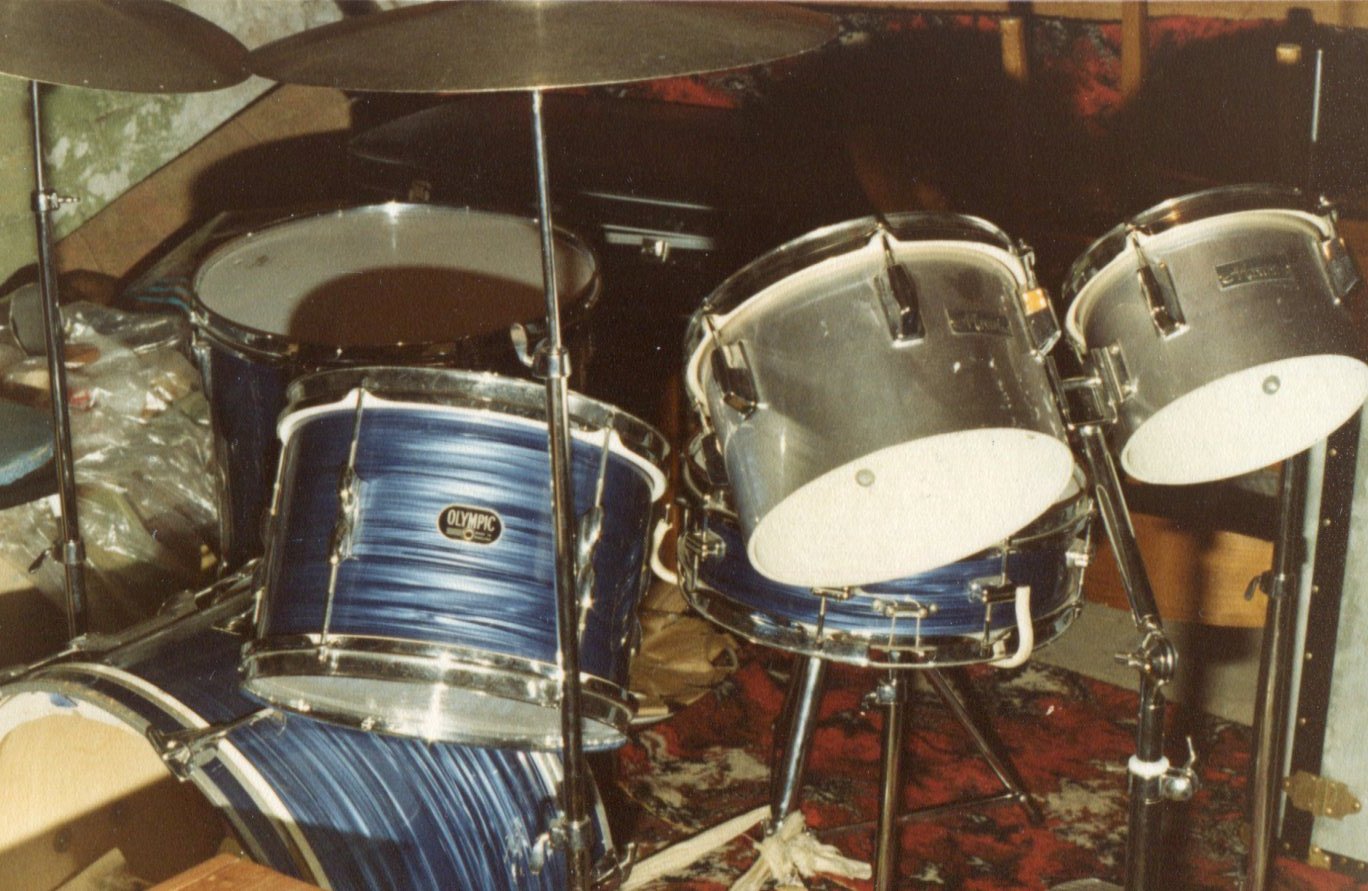
My old 4 piece, 1960's Olympic kit
with additional hanging toms, all in the attic!
Circa 1980.

I had been playing drums since aged 11 and had got my first kit when I was 12. I played mostly rock and roll and pop, but I also played along to a few jazz l.p.'s that were in our house. I would take my record player and amp up to the attic where my blue, 1960's Olympic drum kit was housed, plug in my headphones and bash along to whatever records I took up with me. That was it, right there. At the time I had not played with another musician, unless you counted the time I played in the school band, which I really don't! So we were in this restaurant eating and my dad persuades the pianist to let me play on the drum kit which was there. I was insanely nervous and unprepared. It was not a school audience, but total strangers. I was not performing with peers and friends, but a professional pianist. I had no idea what tunes we were going to play. I think my dad knew the piano player.

Painted Bass Drum, and yes that is a cow bell for a leg!
And the drum sticks are in a Wellington boot!
The pianist asked me for a song I knew and I said, Tiger Rag. I knew this from a live recording of Louis Armstrong and had played it a number of times on my own.  It's a crazy upbeat number, lots of fun. But being jazz, the pianist either played a completely different song, or played a totally different version. Of course, it's jazz! I hung in there. The pianist played another tune and I fell into the music, lost myself to the piano. In storytelling it is called riding the elusive dragon, an image I love and think totally captures the feeling. Some people call it on-form or being on, in the game, or in the moment. It is a place of beauty and magic.

Performing live gives you a high, a buzz, a thrill. But more than that, it connects you with your audience in a way that is unique to performance. You are them, they are you. Some rock musicians say it is better than procreation. I am not sure I can say that is true with storytelling, but it is pretty darn good. This connection is almost spiritual. It connects you with people in ways unlike any other. Ask yourself how you felt after going to a great concert, or what you were feeling after hearing a professional storyteller and were moved in some way by what they were doing.

It turns out we have a similar, quite possibly less intense, experience when we have meaningful conversations. Science had proved there is a very close connection during storytelling. Storytellers and listeners have been hooked up to brain scanners to see how the brain works, and lights up. http://news.sciencemag.org/2010/07/mind-meld-enables-good-conversation Since this 2010 experiment other studies have been done with storytelling. These have shown that the listener and speaker are so in tune with one another that the brain scans show the listener almost anticipates what is going to happen. That is a truly close relationship you're having with a stranger!

Musicians can be seen doing this with each other when jamming. Playing some tune, the guitarist might change accent and rhythm slightly and the drummer and bassist are right on it. Even though it wasn't planned and completely off the cuff, the other musicians felt what was coming and went with that feeling. To the audience it might have sounded rehearsed and well practiced, but it is a spontaneous event of 'magic', if you will. Comedians doing great improv can and do experience these moments. I am sure sports folks also have this moment.

Storytelling has that connection, but instead of with a colleague on the stage, the shared moment is with the listener. Sometimes, when we do our job and the 'planets are aligned', the elusive dragon flies into the space, we jump on its back and ride with the audience, and everyone is transported. Obviously a controlled environment gives the opportunity for this more than a hot and humid room filled with over-heated children, and distracted camp councilors, but it can happen in those places at those times. Then, (under far from perfect circumstances) it is truly magical, it is a magnificent ride with the story. The colours are bright, the smells of the story are strong, and nothing else in the room, or outside the room matters. And later, after the gear is packed up and you're driving home, you know you reached people, and there is that high, buzz, thrill. Maybe you gave the audience a little more joy, maybe more understanding about the world we live in, for all its horrors and hardships. And in those mystical moments we are taken somewhere else, far away and are who we want to be, if only for a moment.
In the moment of joy, July 2015!